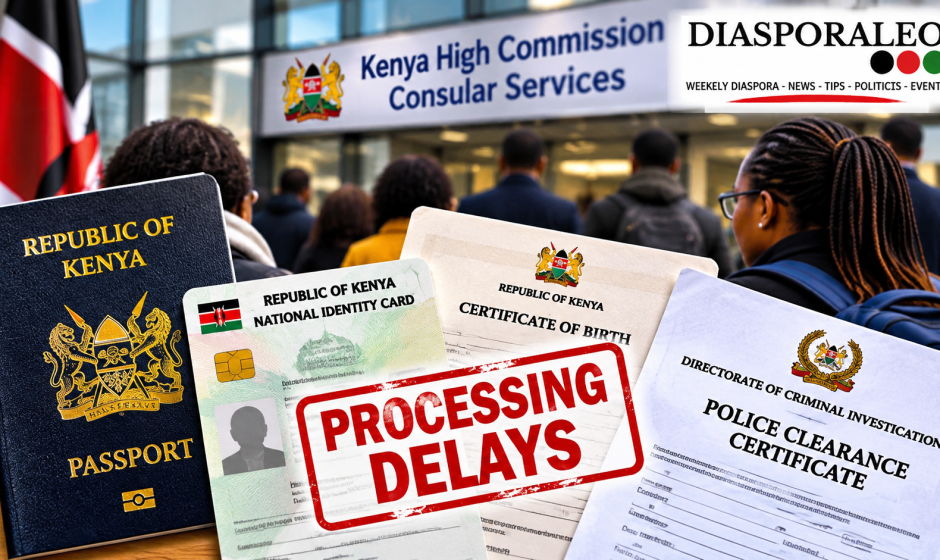


A Kenyan parliamentary report has raised concerns about delays in processing essential documents for citizens living abroad, highlighting coordination problems between diplomatic missions and government departments in Nairobi.
Kenyans living abroad continue to face challenges accessing essential government documents, including national identity cards, birth certificates and police clearance certificates, according to findings presented to the National Assembly on 7 October 2026.
The findings emerged from an inspection conducted by the National Assembly’s Departmental Committee on Defence, Intelligence and Foreign Relations at Kenya’s diplomatic missions in London and Paris in April 2026.
The committee identified coordination difficulties between the Kenyan High Commission in London and government ministries, departments and agencies in Nairobi as a factor affecting the timely delivery of certain consular services.
The revelations raise questions about the efficiency of government services for Kenyans living overseas, particularly those who depend on official documents for employment, immigration procedures and family matters.
Parliament Identifies Delays in Essential Documents
According to the parliamentary report, the Kenyan High Commission in London experiences challenges in delivering certain consular services because some applications require processing or coordination with government departments in Nairobi.
The affected services include:
- Kenyan national identity cards
- Birth certificates
- Police clearance certificates
- Other documents processed centrally by government agencies
The committee noted that coordination with ministries, departments and agencies in Kenya affects the timely delivery of these services.
Although the report identifies administrative challenges, it does not provide specific waiting times, the number of affected applicants or a detailed breakdown of delays for each document.
The findings relate specifically to the London mission and should not be interpreted as evidence that every Kenyan embassy experiences identical problems.
Why These Documents Matter to Kenyans Abroad
For Kenyan citizens living overseas, access to official documentation is essential for maintaining legal and administrative ties with their home country.
National identity cards are important for identification and accessing services in Kenya.
Birth certificates are particularly relevant to Kenyan parents seeking to register children born abroad or establish their children’s identity and family records.
Police clearance certificates are frequently requested by employers, immigration authorities and other institutions conducting background checks.
Delays in obtaining these documents can complicate applications and administrative procedures, particularly when applicants face deadlines imposed by employers or foreign authorities.
However, the parliamentary report does not quantify the financial or personal consequences experienced by applicants.
Dependence on Government Offices in Nairobi
One of the central issues highlighted by the parliamentary committee is the relationship between diplomatic missions and government departments responsible for processing official documents.
While Kenyan embassies and high commissions provide consular assistance, certain documents require involvement from agencies based in Kenya.
This means that improvements at individual diplomatic missions may not fully resolve delays unless coordination with the relevant departments in Nairobi also improves.
The Directorate of Immigration Services confirms that Kenyan missions abroad provide services involving passports, emergency travel documents, national identity cards and birth certificates.
Meanwhile, the Directorate of Criminal Investigations provides procedures for police clearance applications, including arrangements for applicants living outside Kenya.
The parliamentary findings therefore highlight the importance of effective coordination between overseas missions and the agencies responsible for completing applications.
Police Clearance Applications and Digital Services
Kenya’s Directorate of Criminal Investigations allows applicants to request police clearance certificates through the eCitizen platform.
According to the DCI, applicants living abroad can have their fingerprints taken through embassies or high commissions, subject to the applicable procedures.
Once a certificate is ready, applicants can access it through their eCitizen accounts.
The DCI has also been expanding biometric processing systems in Kenya to improve the efficiency of police clearance services.
In October 2026, the agency reported that its Multi-Biometric Identification System had significantly reduced processing times at connected facilities.
However, these improvements do not automatically establish equivalent processing times for applicants overseas, where additional procedures and coordination may be required.
Kenyan High Commission Conducts Outreach Services
The Kenyan High Commission in London has also undertaken efforts to bring consular services closer to diaspora communities outside the British capital.
For example, a mobile consular outreach programme was announced for Leicester on 24 October 2026, offering services such as passport applications, national identity card applications, citizenship-related documentation and birth certificate services.
Such initiatives can reduce the need for Kenyans living outside London to travel to the capital for certain procedures.
Nevertheless, mobile consular services do not necessarily eliminate delays involving documents that require processing by government departments in Kenya.
Parliament Calls for Improved Support for Diplomatic Missions
The parliamentary committee’s inspection also identified financial and operational challenges affecting the London mission.
These included delayed government funding, foreign exchange losses and high operating costs.
Following its visits to London and Paris, the committee recommended timely disbursement of funds to diplomatic missions and improvements to financial arrangements.
Although the report acknowledged opportunities to strengthen services for Kenyan citizens abroad, it did not establish a specific deadline for clearing outstanding identity card, birth certificate or police clearance applications.
The findings nevertheless place renewed attention on the need for effective coordination between Kenya’s diplomatic missions and government agencies responsible for serving citizens overseas.
For Kenyans living in the United Kingdom and elsewhere, the central question remains how quickly government institutions can process essential documents when applications must pass through multiple offices.